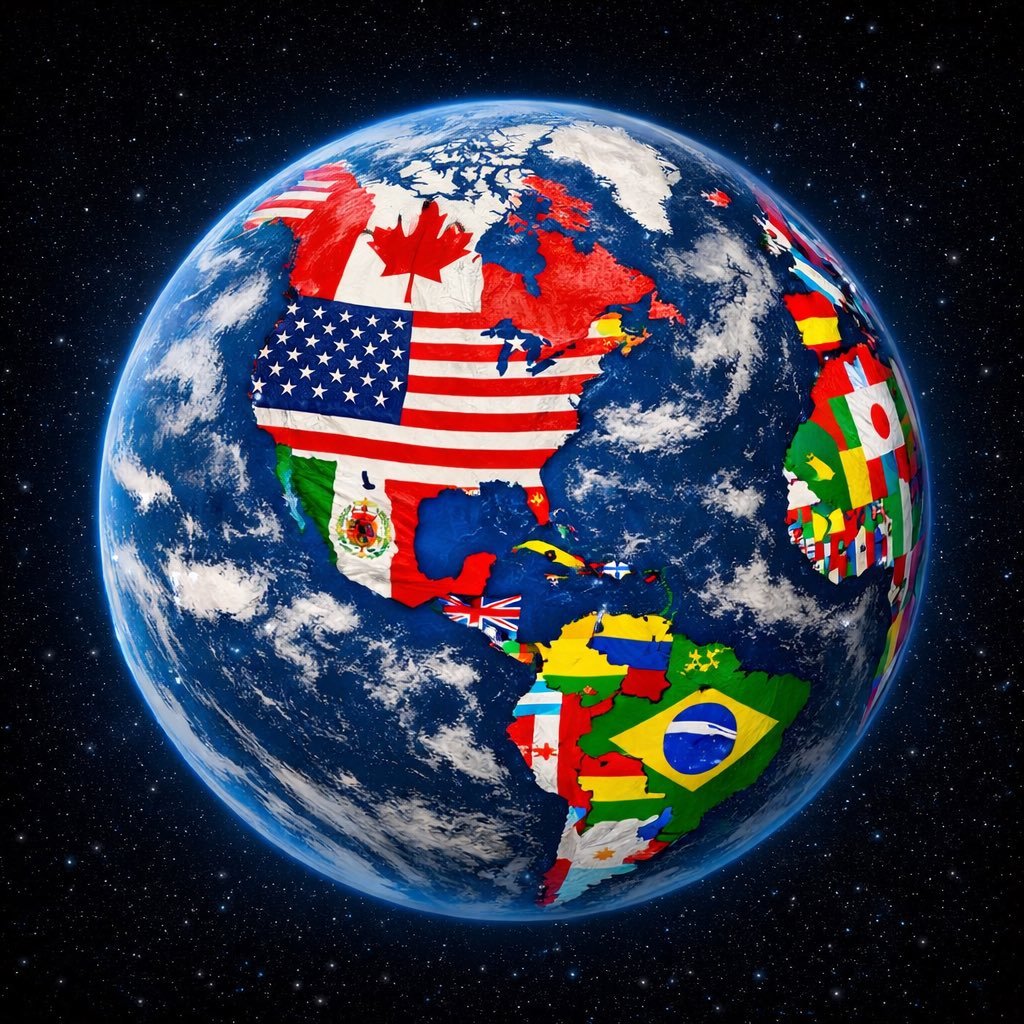
Everyone knows the United States is the world’s sole superpower. Almost nobody can explain what that actually means. It’s not the aircraft carriers or the nuclear arsenal — those are symptoms. American hegemony rests on something far more durable: a global alliance system so deeply embedded in the international order that most people mistake it for the natural state of the world. It isn’t. Someone built it. And understanding its architecture is the first step to understanding why the 21st century looks the way it does.
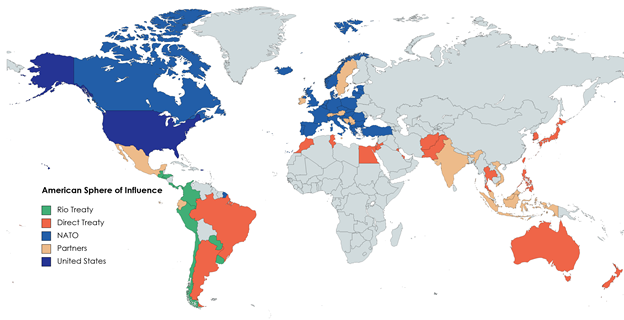
The map above tells a story that no GDP figure or military budget can capture. Every shaded region represents a country bound to the United States through treaties, alliances, or partnership frameworks. This is not soft power. This is the scaffolding of global order — and America holds the blueprints.
NATO: The Shield That Became a System

The North Atlantic Treaty Organization is the most successful military alliance in human history. That’s not hyperbole — it’s arithmetic. Thirty-two member nations spanning from North America to the Baltic states, collectively accounting for over half of global military spending. Article 5 — the mutual defense clause — has been invoked exactly once, after September 11th. The fact that it has rarely needed to be used is precisely the point.
NATO’s genius isn’t its military capability, though that’s formidable. It’s the interoperability. American, British, French, and Polish forces can fight together because they’ve trained together for decades. Their equipment communicates. Their command structures integrate. No other alliance on Earth comes close to this level of operational cohesion.
Critics call NATO an anachronism — a Cold War relic searching for purpose. They’re wrong. NATO exists because the geography of the North Atlantic hasn’t changed. Russia still borders Europe. The Arctic is still melting open. And the lesson of the 20th century — that European great-power wars become world wars — hasn’t expired. NATO didn’t outlive its purpose. Its purpose outlived the Soviet Union.
Five Eyes: The Intelligence Backbone

If NATO is the shield, Five Eyes is the nervous system. The United States, United Kingdom, Canada, Australia, and New Zealand share signals intelligence at a depth that no other nations on Earth replicate. This isn’t a treaty of convenience — it’s an anglophone intelligence fusion that dates to World War II codebreaking and has only deepened since.
Five Eyes matters because information is the ultimate force multiplier. Every major American strategic decision of the past seventy years has been informed by intelligence shared across this network. The geographic coverage is staggering: North America, Europe, the Pacific, and the Southern Hemisphere, all feeding into a unified analytical framework.
What makes Five Eyes different from every other intelligence-sharing agreement is trust. These five nations share raw intelligence — not summaries, not sanitized reports. Raw feeds. That level of trust took decades to build and cannot be replicated by fiat. China can build aircraft carriers. It cannot build Five Eyes.
The Base Network: Geography as Strategy

The United States maintains approximately 750 military bases in at least 80 countries. No other nation comes close. The next largest overseas military footprint belongs to the United Kingdom, with roughly 145 sites. Russia and China combined barely break double digits.
This isn’t imperialism by another name — though critics love that framing. It’s logistics. The ability to project power anywhere on Earth within 48 hours requires pre-positioned equipment, maintained airfields, and relationships with host nations that take generations to build. When a crisis erupts in the South China Sea or the Strait of Hormuz, the question isn’t whether America can respond. It’s how fast.
The base network also serves a deterrence function that’s impossible to quantify but essential to understand. American forces stationed in South Korea, Japan, Germany, and the Gulf states aren’t there primarily to fight. They’re there so that fighting becomes unnecessary. A tripwire that turns any regional aggression into a confrontation with the United States military is the most cost-effective peacekeeping tool ever devised.
COFA: The Pacific You’ve Never Heard Of

The Compact of Free Association is the most strategically important agreement that virtually no American can name. Through COFA, the United States maintains exclusive military access to a vast swath of the Pacific Ocean via agreements with the Marshall Islands, the Federated States of Micronesia, and Palau.
Why does this matter? Because the Pacific is where the 21st century will be decided. COFA gives America strategic depth across the world’s largest ocean — a buffer zone between the US homeland and any Pacific adversary. The Kwajalein Atoll in the Marshall Islands hosts the Ronald Reagan Ballistic Missile Defense Test Site. You don’t build missile defense infrastructure on someone else’s territory without a relationship deeper than most alliances.
COFA nationals can live and work in the United States without visas. They serve in the US military at rates higher than most American states. This is not a colonial relationship — it’s a partnership where small Pacific nations trade strategic access for economic support, federal services, and freedom of movement. It works because both sides need it.
OAS: The Hemispheric Framework
.svg)
The Organization of American States is the oldest regional organization in the world, predating the United Nations. Its 35 member states encompass every independent nation in the Western Hemisphere. The Monroe Doctrine declared the Americas off-limits to European colonialism in 1823. The OAS is what that doctrine looks like with institutional clothing.
The OAS is not without its problems. Venezuela’s participation has been suspended. Cuba was excluded for decades. Critics from both left and right argue it serves as a rubber stamp for American preferences in the hemisphere. Some of that criticism lands.
But the strategic logic is sound. A stable Western Hemisphere means the United States can focus its attention outward — toward Europe, the Middle East, and the Indo-Pacific — without worrying about threats in its own backyard. Every dollar spent on hemispheric stability through the OAS is a dollar saved on defending the homeland. That’s not charity. That’s strategic investment.
What Should Happen
Americans need to understand this system before they can have honest debates about foreign policy. Every argument about defense spending, overseas deployments, or alliance commitments is meaningless without grasping the architecture described above.
We should maintain and modernize these alliances — not because of nostalgia, but because the alternatives are worse. A world without NATO is a world where European security depends on individual nations making rational decisions. History suggests they won’t. A world without Five Eyes is a world where America’s intelligence advantage evaporates. A world without the base network is a world where crises metastasize before we can respond.
The American alliance system is expensive. It is also the cheapest insurance policy in the history of statecraft. We built this architecture because two world wars taught us what happens without it. The question isn’t whether we can afford to maintain it. The question is whether we can afford not to.
Further Reading
- The Accidental Superpower by Peter Zeihan — why America’s geography built the most powerful alliance system in history
- The Grand Chessboard by Zbigniew Brzezinski — the blueprint for American geostrategy in Eurasia
- The Revenge of Geography by Robert D. Kaplan — how the physical landscape shapes alliances and conflict