The war in Ukraine is the best strategic investment the United States has made since the Marshall Plan. For roughly $100 billion — a fraction of the annual defense budget — America is degrading a primary adversary’s military, revitalizing a decaying alliance, decoupling Western economies from hostile energy dependence, stress-testing its own supply chains, and modernizing NATO’s equipment inventory. All without a single American soldier in combat. Name a defense program in history that delivered this return on investment. You can’t.
War is horrific, and the Ukrainians fighting it know that firsthand. Russian aggression is the cause of this conflict — Ukraine is fighting a long-delayed war of independence from its former imperial power. It would be better if there were no war at all. But on a strategic lens, this conflict is profoundly beneficial to the United States and the Western order. Saying so isn’t callous. It’s honest. And honesty about interests is the foundation of good policy.
The Battlefield Reality
Most observers expected Kyiv to fall in days. The northern offensive reached the capital’s outskirts, and had it not been for Russian incompetence and exceptional Ukrainian defensive maneuvers, this war would have ended with a Putin victory. It didn’t.
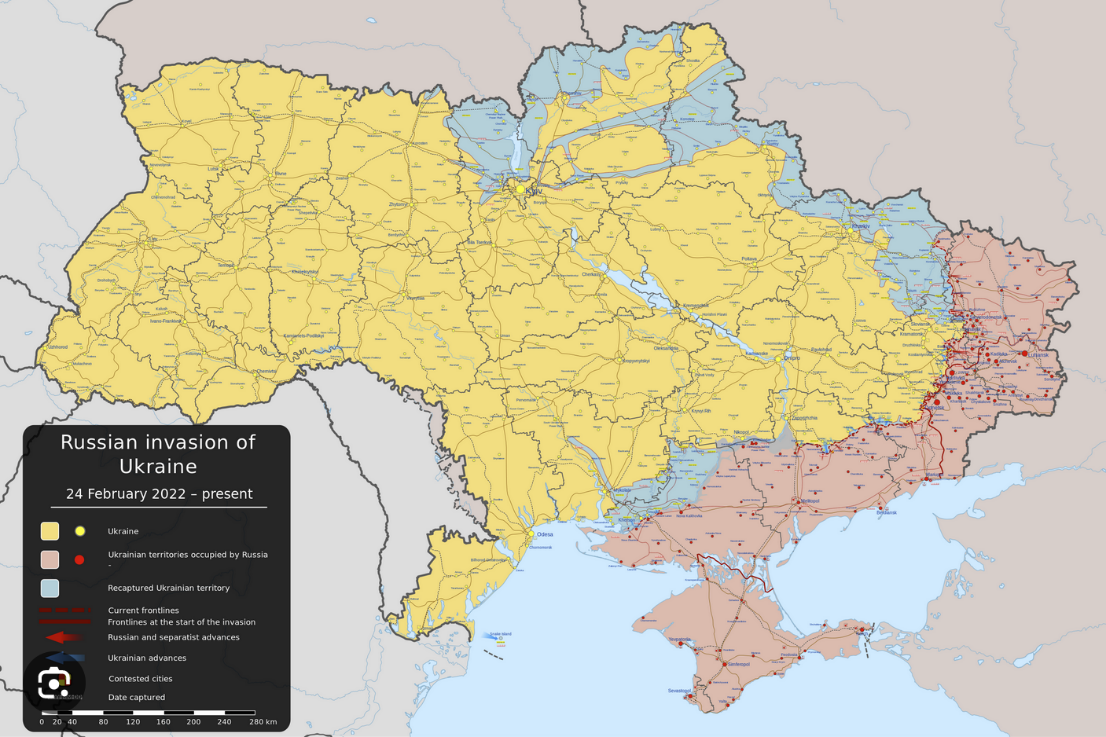
Russia now defends a 300-mile front against an increasingly capable opponent. The Kerch Bridge connecting Crimea to Russia has been damaged and remains vulnerable to drone strikes. If supply lines through southeastern Ukraine are severed, Russia’s position in Crimea becomes untenable. Putin’s forces remain potent, but they’re bleeding — in men, in equipment, and in the strategic reserves that would be needed for any future adventurism. Every Russian tank destroyed in Donbas is a tank that will never threaten a NATO border.
Russia Is in Retreat Everywhere
The war hasn’t just weakened Russia in Ukraine. It’s exposed the limits of Russian power globally. The most telling example: Armenia. Russia and Armenia had a mutual defense relationship for decades, with Russian peacekeepers stationed in the contested Nagorno-Karabakh region. When Azerbaijan launched its offensive in September 2023, Russia did nothing. Its ally called for help. Moscow couldn’t answer — its forces were committed to Ukraine.
The message was received worldwide. Countries that relied on Russian security guarantees now know those guarantees are hollow. Russian influence in Central Asia, the Caucasus, and Africa is contracting. Wagner Group’s operations — Moscow’s preferred tool for projecting power on the cheap — have been disrupted by Prigozhin’s mutiny and death. The empire is receding.
Some of these countries will fall under other spheres of influence — China, Iran, Turkey. But the primary opponent to European stability is being crippled. That’s worth the price of admission alone.
The Trade Interdependence Myth Is Dead
The neoliberal article of faith — that trade prevents conflict and interdependence guarantees peace — died in February 2022. Russia was Europe’s primary energy supplier. Germany imported 34% of its crude oil and over 50% of its natural gas from Russia. The theory said this interdependence made war unthinkable. The theory was wrong.
This shouldn’t have been surprising. The largest trade relationship Great Britain had before World War II was with Germany. Trade doesn’t prevent war. It gives aggressors leverage.
The decoupling now underway — painful as it is — will produce a more resilient Western economy. European nations are diversifying energy sources, building LNG terminals, and investing in renewables at emergency speed. Supply chains are being rerouted through allied nations. Yes, this contributed to inflation. Short-term struggle for long-term gain. A Europe that doesn’t depend on Russian gas is a Europe that can’t be blackmailed. That’s worth every penny of temporarily higher energy bills.
NATO Was Dying. Now It Isn’t.
Before the invasion, NATO was in genuine crisis. Macron called it “brain dead.” The Afghanistan withdrawal was a debacle that shattered allied confidence in American leadership. European defense spending was anemic. The transatlantic relationship was drifting as Europe pursued engagement with Russia and China at America’s expense, while Americans grew exhausted footing the defense bill for allies who wouldn’t invest in their own security.
The war in Ukraine reversed all of it overnight. Finland and Sweden joined NATO — two historically neutral nations that watched Russia invade a neighbor and concluded that neutrality was no longer viable. Germany committed to 2% of GDP defense spending and announced a €100 billion special military fund. Poland is building the largest conventional army in Europe. The alliance hasn’t been this unified or this purposeful since the Cold War.
Putin didn’t just fail to prevent NATO expansion. He catalyzed the most significant strengthening of the alliance in a generation. History will record this as one of the great strategic miscalculations of the 21st century.
The Supply Chain Dividend
Here’s what the critics miss when they quote the aid price tag: the United States isn’t shipping pallets of cash to Kyiv. The bulk of military aid consists of equipment the US already owned — much of it aging inventory that was scheduled for decommissioning or expensive long-term storage. Sending Bradleys and M113s to Ukraine isn’t a cost. It’s a clearance sale that frees up warehouse space and maintenance budgets.
The replacement cycle is the real strategic play. As old stock goes to Ukraine, American defense contractors are producing new equipment — next-generation systems that will be superior to what they replaced. This isn’t waste. It’s an accelerated modernization program funded by the urgency of a real war. The US military is cycling out Cold War-era inventory and replacing it with equipment designed for the threats of the 2030s and beyond.
The production lines matter as much as the products. Before Ukraine, American munitions production had atrophied to peacetime levels. The 155mm artillery shell shortage exposed a dangerous reality: the US industrial base couldn’t sustain a major conflict. Ukraine forced a correction. Production capacity for shells, missiles, and drones is scaling up — not just for Ukraine, but for the potential Pacific conflict that every defense planner knows is the real test. If China moves on Taiwan, the United States will need a defense industrial base operating at wartime tempo. Ukraine is the rehearsal.
Allied procurement amplifies the effect. European nations that depleted their own stockpiles supporting Ukraine are now restocking — and they’re buying American. F-35s, HIMARS, Patriot systems, Javelin missiles. NATO interoperability improves with every purchase because the alliance converges on common platforms. The old Soviet-era equipment that Eastern European nations donated to Ukraine is being replaced with American systems that can actually communicate with each other on a modern battlefield. The net result is a NATO alliance that is better armed, more interoperable, and more industrially prepared than at any point since 1991.
The Risk Is Real — And Worth Taking
No one knows how this war ends. It’s possible that support proves excessive in hindsight, or that it prolongs a conflict that might have frozen sooner. Ukraine could emerge as a heavily armed NATO neighbor with its own agenda. Russia could lose so catastrophically that nuclear escalation becomes a genuine risk — a cornered state with 6,000 warheads is nobody’s idea of stability.
These risks are real. They deserve serious analysis, not dismissal. But the purpose of defense spending is the protection of the country and its allies, and by that measure the math works. For approximately $100 billion, the United States has achieved the degradation of Russia’s conventional military, the revitalization of NATO, the decoupling of Western energy from a hostile power, the modernization of allied equipment inventories, the expansion of American defense production capacity, and the demonstration — to every potential adversary watching — that aggression against the Western order carries a price that no rational actor should want to pay.
That’s not charity. That’s the most cost-effective defense investment in American history.
Slava Ukraini.